Forging Independence: How American Tech Is Rebuilding Its Industrial Backbone Away From China
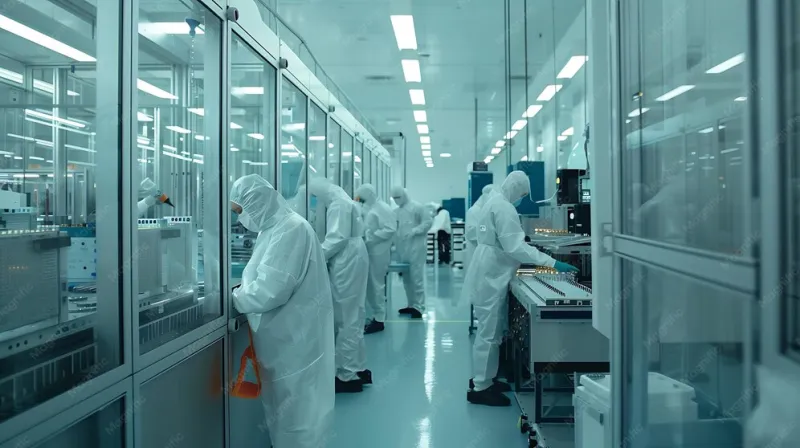
Photo: semiconductor manufacturing facility clean room workers USA, via img.freepik.com
For decades, the phrase "assembled in China" was not merely a label — it was the foundational logic of the global technology supply chain. Cheap labor, vertically integrated manufacturing clusters, and an infrastructure ecosystem built over thirty years made China the indispensable center of gravity for everything from consumer electronics to enterprise server hardware. That logic is now being systematically dismantled.
Driven by a convergence of geopolitical friction, pandemic-era disruptions, and legislative momentum — most notably the CHIPS and Science Act of 2022 — American technology companies are engineering supply chains that prioritize resilience over pure cost efficiency. The transition is neither swift nor inexpensive. But the structural foundations are being laid, and the implications for the broader technology sector are profound.
The Fault Lines That Forced the Reckoning
The vulnerabilities in China-dependent supply chains did not emerge overnight. The 2018 trade war introduced tariff unpredictability that forced procurement teams to model scenarios they had previously treated as theoretical. The COVID-19 pandemic then converted those theoretical vulnerabilities into operational crises: factory shutdowns in Shenzhen and Wuhan cascaded into product launch delays, inventory shortfalls, and contractual failures across the technology industry.
The geopolitical dimension added a harder edge. Heightened tensions over Taiwan — home to TSMC, the world's most critical semiconductor foundry — introduced a category of supply chain risk that no insurance policy could fully hedge. For US technology companies, the calculus shifted: the cost of diversification, once viewed as prohibitive, began to look modest against the cost of a catastrophic single-point failure.
Semiconductor Sovereignty: The Arizona Bet
No initiative better illustrates America's industrial ambitions than the cluster of semiconductor fabrication plants taking shape in the Phoenix metropolitan area. TSMC's Arizona facilities, backed by billions in federal incentives and private investment, represent the most visible symbol of domestic semiconductor production. Intel's parallel investment in its Ohio "Silicon Heartland" campus further signals that the US is serious about reclaiming a manufacturing capability it largely ceded over the prior three decades.
Yet the engineering challenges are substantial. Semiconductor fabrication is among the most technically demanding manufacturing processes in existence, requiring ultra-pure water systems, vibration-controlled environments, and a workforce with highly specialized expertise. Recruiting and training that workforce domestically has proven slower than initial projections anticipated. TSMC's Arizona timeline adjustments — pushed in part by skilled labor shortfalls — underscore that industrial policy alone cannot override the realities of human capital development.
The CHIPS Act's $52 billion in funding has catalyzed activity, but industry analysts caution that federal investment is a catalyst, not a substitute for the decades of institutional knowledge embedded in Asian manufacturing ecosystems. Closing that gap will require sustained investment in STEM education pipelines, apprenticeship programs, and university-industry research partnerships.
Nearshoring to Mexico: Proximity as Strategic Advantage
While domestic semiconductor fabrication commands headlines, a quieter but equally consequential shift is occurring across the southern border. Mexico has emerged as the preferred nearshoring destination for a wide range of electronics assembly, printed circuit board manufacturing, and component production — activities that require cost-competitive labor but benefit enormously from geographic proximity to US markets.
The Monterrey-Guadalajara industrial corridor has attracted significant investment from companies seeking to replace Chinese contract manufacturing with operations that sit within the same time zone as their US engineering teams. The logistical advantages are tangible: shorter transit times reduce working capital requirements, enable more responsive inventory management, and allow for faster design iteration cycles. Under the United States-Mexico-Canada Agreement (USMCA), favorable trade terms further reduce the cost differential between Mexican and Chinese production.
Companies including Foxconn, HP, and multiple Tier-2 suppliers have expanded their Mexican manufacturing footprints materially since 2020. The challenge, as with domestic reshoring, lies in capacity scaling. Mexico's electronics manufacturing infrastructure, while growing rapidly, is not yet equipped to absorb the full volume that China currently handles. Infrastructure investment — in industrial parks, power grid reliability, and workforce training — will need to accelerate significantly to meet demand.
Central America's Emerging Role
Beyond Mexico, a handful of Central American nations — particularly Costa Rica and Honduras — are positioning themselves as viable locations for specific technology manufacturing and assembly operations. Costa Rica, with its established medical device manufacturing base and educated workforce, has attracted interest from electronics firms seeking environments with stronger intellectual property protections and lower political risk profiles than some alternative nearshoring destinations.
These markets remain nascent in the context of global technology supply chains, but their trajectory is worth monitoring. As nearshoring competition in Mexico intensifies, and as labor costs in the Monterrey corridor creep upward, Central American locations may absorb overflow capacity — particularly for higher-value, lower-volume manufacturing operations.
The Engineering Architecture of Resilience
Beyond geography, US technology manufacturers are redesigning supply chain architecture itself. The dominant model of the past — lean, just-in-time, single-source — is giving way to what supply chain engineers describe as "resilient by design" frameworks. These approaches deliberately introduce redundancy: dual-sourcing critical components, maintaining strategic inventory buffers, and qualifying alternative suppliers across multiple geographies before they are needed.
Digital supply chain platforms are playing an increasingly important role in this transition. Real-time visibility tools, AI-driven demand forecasting, and supplier risk monitoring systems allow procurement teams to identify concentration risks before they become operational crises. Companies that had invested in these capabilities prior to 2020 navigated the pandemic disruptions measurably better than those operating on legacy procurement systems.
For technology leaders evaluating their own supply chain posture, the analytical framework has fundamentally changed. The question is no longer simply "what is the lowest cost source?" but rather "what is the risk-adjusted total cost of supply, accounting for geopolitical exposure, logistics volatility, and single-source concentration?"
The Long Arc of Industrial Realignment
It would be a mistake to characterize this transition as clean or complete. China remains deeply embedded in global technology supply chains, and full decoupling — even if desirable — is not achievable within any near-term planning horizon. Chinese manufacturers continue to hold advantages in certain component categories, rare earth material processing, and legacy electronics assembly that will not be replicated quickly elsewhere.
What is underway is better described as de-risking rather than decoupling: a deliberate reduction of single-country concentration, combined with the construction of alternative manufacturing capabilities that did not previously exist at meaningful scale.
For the US technology sector, this realignment represents both a challenge and an opportunity. Companies that invest now in diversified supply architectures, domestic manufacturing capabilities, and nearshore partnerships will be structurally better positioned when the next disruption — whether geopolitical, environmental, or epidemiological — arrives. Those that treat current stability as a reason to defer diversification may find themselves revisiting painful lessons already learned.
The silicon anvil is being struck. The shape of the American technology supply chain is being forged in real time — and the decisions made in this decade will define the industry's resilience for the next.