The Architecture of Independence: How US Enterprises Are Building AI on Their Own Terms
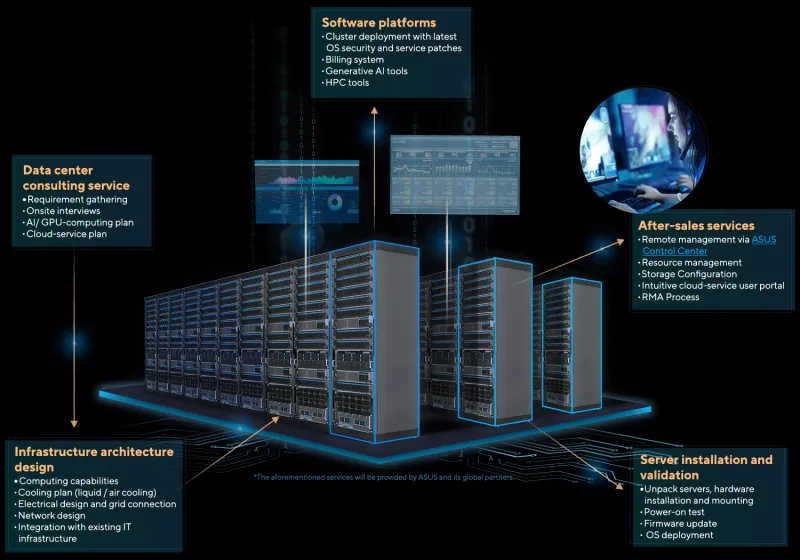
Photo: proprietary AI server infrastructure data center enterprise computing, via www.asus.com
For much of the past five years, the dominant narrative in enterprise AI adoption has centered on accessibility. Cloud providers and foundation model vendors have invested heavily in lowering the barrier to AI deployment, offering API-based access to powerful models with minimal infrastructure overhead. For many organizations, this approach delivered genuine value quickly. For others, it quietly introduced a form of technological dependency that is now prompting serious strategic reconsideration.
Across a range of US industries — from automotive and social media to financial services and defense contracting — a deliberate countermovement is underway. Engineering and executive leadership at these organizations are asking a foundational question: what does it mean to truly own an AI capability, rather than rent access to one?
The Dependency Problem in Concrete Terms
The risks embedded in third-party AI dependency are not hypothetical. They manifest along several distinct dimensions that compound over time.
Cost structure is the most immediately visible concern. Organizations that scaled AI-powered features on the assumption of stable API pricing have encountered significant budget volatility as model providers adjust their pricing tiers, deprecate existing models, or restructure access policies. For enterprises where AI inference is embedded in high-volume, customer-facing workflows, these fluctuations translate directly into unpredictable operational expenditure.
Data governance presents a second, arguably more serious challenge. When sensitive business data — customer records, proprietary transaction histories, internal communications — passes through a third-party model provider's infrastructure, the enterprise loses a meaningful degree of control over how that data is handled, stored, and potentially used for model improvement. For organizations operating under stringent regulatory frameworks, including financial institutions subject to federal oversight or defense contractors with security clearance requirements, this exposure is not merely uncomfortable. It is, in many cases, operationally untenable.
Finally, there is the strategic dimension of model dependency. An organization whose core AI capabilities are built on a foundation model it does not control is, in effect, outsourcing a critical element of its competitive differentiation to a vendor whose priorities may not align with its own. Model updates, capability changes, or service discontinuations can disrupt products and workflows with little advance notice and no recourse.
How the Pioneers Are Building
The enterprises that have moved most aggressively toward AI sovereignty offer instructive architectural models. Tesla's approach to autonomous driving AI is among the most extensively documented examples of vertically integrated AI infrastructure in American industry. Rather than relying on external perception or inference systems, the company developed its own training hardware, the Dojo supercomputer, alongside proprietary model architectures optimized for its specific operational requirements. The resulting system is not merely a product feature — it is an infrastructural moat that competitors cannot replicate by purchasing access to the same external tools.
Meta has pursued a comparable strategy through its investment in open-weight model development, most prominently through the LLaMA model family. By releasing foundation models that can be deployed and fine-tuned on internal infrastructure, the company has constructed an AI capability stack that it controls end-to-end, while simultaneously contributing to the broader research ecosystem. The strategic calculus is clear: if powerful foundation models are widely available, the competitive advantage shifts toward the organization with the most sophisticated fine-tuning pipelines, the richest proprietary training data, and the most efficient inference infrastructure — all of which Meta controls internally.
Beyond these high-profile cases, a wider set of enterprises across sectors including healthcare, logistics, and enterprise software are pursuing more targeted forms of AI independence. Rather than attempting full vertical integration from the outset, these organizations are identifying the specific AI capabilities most central to their competitive positioning and building ownership there first, while continuing to use third-party solutions for peripheral applications.
The Build-Versus-Buy Calculus
The decision to invest in proprietary AI infrastructure is not universally correct, and the organizations navigating this transition most effectively are those that apply rigorous economic analysis rather than ideological commitment to either approach.
The primary cost drivers of building in-house AI capability include compute infrastructure — whether on-premises GPU clusters or dedicated cloud instances — data engineering capacity to construct and maintain training pipelines, and the specialized machine learning talent required to develop, evaluate, and iterate on models. These costs are substantial, and for organizations with limited AI use cases or low inference volume, they may not be justified.
However, the break-even analysis shifts considerably for enterprises with high inference volume, sensitive data requirements, or AI capabilities that are genuinely central to product differentiation. At scale, the per-inference cost of internally hosted models typically falls well below API-based alternatives. The upfront investment in infrastructure and talent becomes, over a multi-year horizon, a source of structural cost advantage rather than a burden.
Emerging Architectural Patterns for AI Sovereignty
Several architectural approaches are gaining traction among US enterprises pursuing greater AI independence. Retrieval-augmented generation frameworks, which combine locally hosted language models with enterprise-specific knowledge bases, allow organizations to deploy capable AI systems without transmitting sensitive data to external providers. Fine-tuning smaller, open-weight models on proprietary datasets has emerged as a cost-effective path to task-specific performance that rivals larger general-purpose models on targeted applications.
Hybrid deployment architectures — in which a base model is hosted on internal infrastructure while compute-intensive training workloads are offloaded to dedicated cloud instances — offer a pragmatic middle path for organizations that cannot yet justify full on-premises buildout. These approaches preserve data governance control over the most sensitive operational workflows while managing capital expenditure.
Model evaluation and governance tooling is also maturing rapidly. Enterprises building internal AI capabilities are investing in systematic frameworks for assessing model behavior, detecting drift, and auditing outputs — capabilities that are difficult to implement when the underlying model is a black box operated by an external vendor.
Sovereignty as Strategic Infrastructure
The organizations moving toward AI self-sufficiency are not uniformly motivated by cost savings or risk mitigation alone. Many are making a longer-horizon strategic bet: that in a competitive environment where AI capability is increasingly central to product differentiation and operational efficiency, the enterprises that own their AI infrastructure will hold a structural advantage over those that rent it.
This framing aligns with a broader pattern in the history of enterprise technology. Organizations that treated computing infrastructure, data storage, and networking as strategic assets — rather than commodity services to be outsourced entirely — consistently emerged from technology transitions with stronger competitive positions than those that optimized purely for short-term cost efficiency.
For engineering leaders at US enterprises, the practical implication is not necessarily to abandon third-party AI tools immediately. It is to evaluate current AI dependencies with the same strategic rigor applied to any critical infrastructure decision, and to begin building the internal capabilities that will matter most as AI moves from experimental to foundational across every industry.